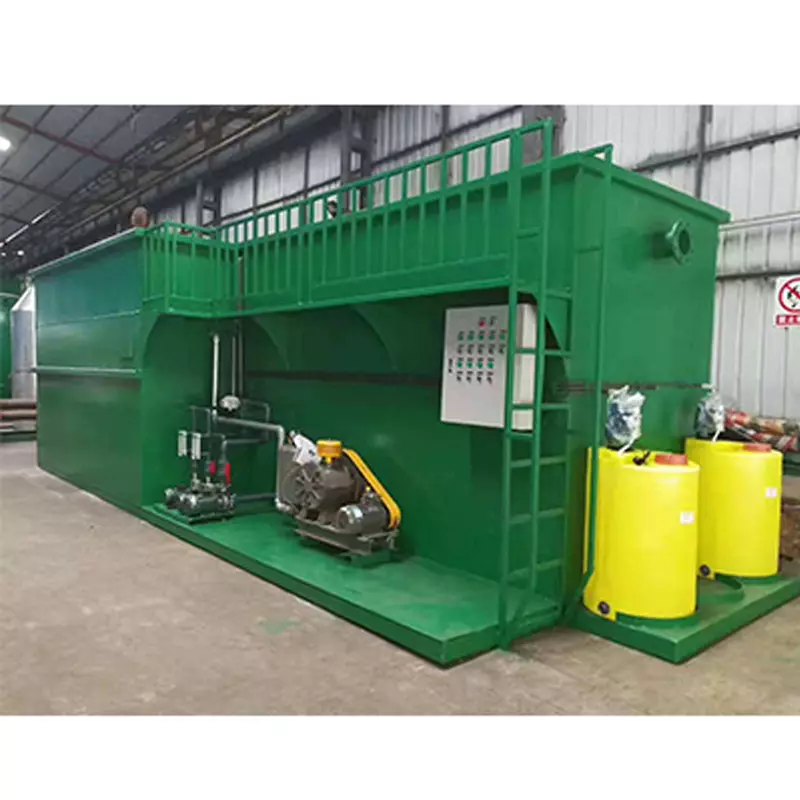
Product details description of medical sewage treatment equipment
Product Overview
The integrated medical sewage treatment equipment developed and produced by Guangdong Hanluo Environmental Protection Technology Co., Ltd. is an intelligent treatment system designed for the comprehensive sewage generated by medical institutions such as hospitals, clinics, disease control centers, laboratories, and physical examination centers. This equipment strictly adheres to the "Discharge Standard of Water Pollutants for Medical Institutions" and relevant national environmental protection regulations. It adopts a mature combined process of "pretreatment + biological treatment + deep disinfection" to ensure that the effluent is stably discharged up to standard or safely reused, effectively killing pathogens and eliminating secondary pollution. It is a reliable choice for medical institutions to fulfill their environmental protection responsibilities and safeguard public health security.
Core processing technology and flow
Our equipment adopts a modular design, and the process can be flexibly combined according to the raw water quality and discharge standards. The typical process is as follows:
Pretreatment unit
Grid: It intercepts larger suspended solids and debris in the sewage, such as gauze and cotton swabs, to protect subsequent equipment.
Regulating tank: Balances water quality and quantity, reduces the shock load on subsequent treatment units, and is equipped with an internal lift pump.
Sedimentation/air flotation unit (optional) : It is used for the preliminary physical and chemical separation of wastewater containing special drugs, developers or high suspended solids.
Core biological treatment unit
A/O (anaerobic-aerobic) biological contact oxidation process: This is the core of the equipment. The anaerobic section degrades large-molecule organic substances and removes nitrogen. The aerobic section, through the microbial film attached to the high-efficiency biological filler, strongly decomposes organic matter (BOD/COD), ammonia nitrogen and other pollutants. It has the advantages of high treatment efficiency, low sludge production and strong shock resistance.
MBR (Membrane Bioreactor) process (high-end optional) : It combines biological degradation with membrane efficient separation technology, resulting in excellent effluent quality (up to reuse standards), high sludge concentration, smaller land occupation, and high degree of automation.
Deep disinfection and sterilization unit (key)
Chlorine dioxide disinfection generator/sodium hypochlorite disinfection system: Highly efficient, broad-spectrum and long-lasting, it can completely inactivate bacteria, viruses (including fecal coliform bacteria, enteroviruses, etc.) and pathogens contained in medical sewage, ensuring the biological safety of the discharged water. Residual chlorine online monitoring instruments can be equipped as required.
Ultraviolet disinfection device (optional or in combination) : Physical disinfection method, no secondary pollution. When used in combination with chemical disinfection, it can enhance protection and reduce the dosage of disinfectant.
Sludge Treatment and Intelligent Control
Sludge thickening tank: Regularly thickens the small amount of excess sludge produced, which can then be entrusted to a qualified unit for treatment or be equipped with an integrated sludge dewatering device.
Fully automatic intelligent control system: The equipment is equipped with a PLC control cabinet, which can achieve automatic operation, liquid level protection, fault alarm, and remote monitoring (optional). It is easy to operate and manage, reducing labor costs.
Core features and advantages of the product
High efficiency and compliance, safe and reliable: The process is mature and stable, ensuring that the effluent meets the GB 18466-2005 discharge standard. Emphasis is placed on enhancing the disinfection effect to prevent the spread of pathogens.
Fully buried/flexible installation on the ground: The equipment can be fully buried underground, and the surface can be used for greening and parking, saving space. It can also be installed on the ground and is suitable for sites with special requirements.
Modular design, strong shock resistance: In view of the large fluctuations in medical sewage quality, the pretreatment and regulation capabilities are strengthened. The biological system is shock-resistant and operates stably.
Intelligent operation and simple management: With a high degree of automation, it supports unattended operation and has the potential for remote monitoring, significantly reducing the difficulty and cost of operation and maintenance.
Low noise and low odor: Optimized design, using high-quality fans and sealing measures, has a minimal impact on the surrounding environment.
Durable and anti-corrosive, with a long service life: The main structure is made of carbon steel with anti-corrosion treatment (epoxy asphalt/fiberglass reinforced plastic), stainless steel or corrosion-resistant composite materials, ensuring the long-term stable operation of the equipment in harsh environments.
Application scope
General hospitals, specialized hospitals, and traditional Chinese medicine hospitals
Township health centers and community medical service centers
Dental clinics, medical beauty institutions, physical examination centers
Disease control center, blood station, laboratory
Pet hospitals, veterinary stations
Other institutions that produce wastewater of similar nature
Technical parameters (examples, customizable according to specific models)
Water treatment capacity: 1m³/d to 500m³/d (customizable according to requirements)
Influent and effluent water quality: Meet or exceed the pretreatment or direct discharge standards stipulated in the "Discharge Standard of Water Pollutants for Medical Institutions".
CODcr removal rate: ≥ 90%
BOD5 removal rate: ≥ 92%
SS removal rate: ≥ 93%
Ammonia nitrogen removal rate: ≥ 85%
Fecal coliform count: Strictly up to standard (< 500 per liter)
Power supply: 380V/220V, 50Hz
Control system: PLC automatic control, touch screen human-machine interface
Equipment noise: ≤ 60 dB(A)
Our service commitment
Adhering to the philosophy of "establishing a career with professionalism and meeting needs with responsibility", we not only provide equipment but also offer full-process solutions
Free consultation and solution design: One-on-one research by engineers, providing customized process solutions and budgets.
High-standard production and installation: Modular prefabrication in the factory and rapid assembly on site to ensure project quality.
Professional commissioning and training: On-site commissioning to the optimal state, and system operation training for medical staff or property management.
Comprehensive after-sales maintenance: We offer a full range of services including regular inspections, supply of consumables, and emergency repairs, and aim to establish long-term cooperative relationships.
Choosing Hanlo means choosing a solid commitment to the environment and public health. Let's join hands and contribute to creating a safer medical environment.