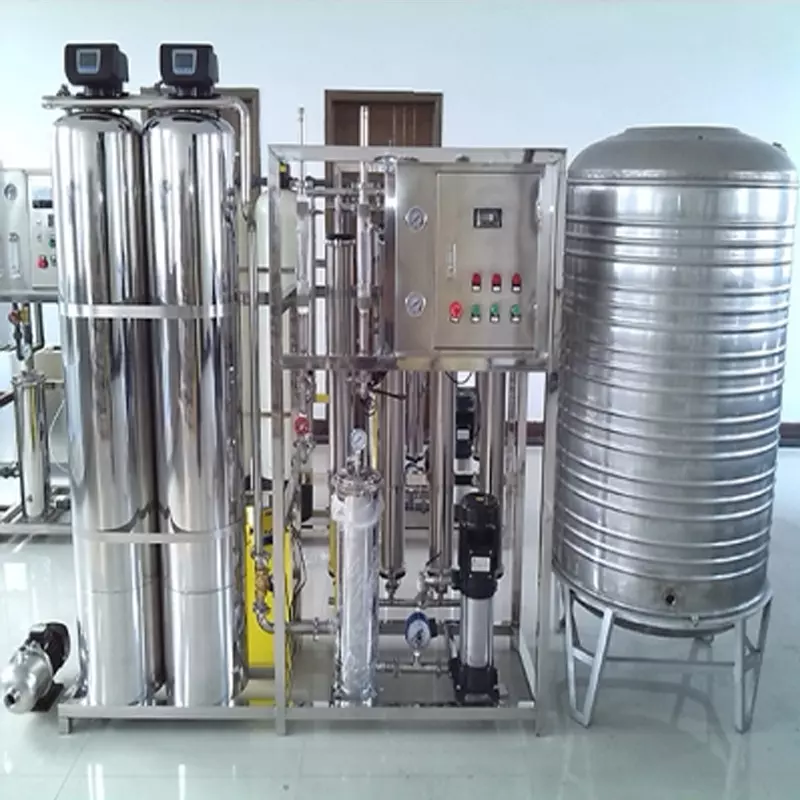
Guangdong Hanluo Environmental Protection Technology - Solutions for Reclaimed Water Recovery and Circulating Water Treatment Systems
Product Positioning: Committed to enabling enterprises to achieve efficient recycling of water resources, significantly reduce fresh water consumption and sewage discharge costs, and provide customized system solutions that combine economic and environmental benefits.
System Overview
Our reclaimed water recycling system, also known as "reclaimed water reuse" or "water resource recycling system", focuses on properly treating production wastewater, domestic sewage or rainwater, etc., to meet the prescribed water quality standards, and then using it for non-potable purposes such as industrial production cooling, process flushing, green irrigation, road cleaning, landscape water replenishment and toilet flushing. This system is a key environmental protection facility for industrial enterprises to achieve energy conservation and emission reduction and create "green factories".
Core processing technology and techniques
We adopt the modular design concept of "differentiated treatment and graded reuse", and flexibly combine the following advanced unit processes based on the quality of raw water and the standards of reclaimed water:
Pretreatment unit
Grid screen: Removes large suspended particles and fibrous impurities.
Regulating tank: Homogenize water quality and quantity to ensure the stable operation of subsequent processes.
Coagulation sedimentation and air flotation: By adding chemicals, it efficiently removes suspended solids, colloids, some organic matter and oils.
Core processing unit (select the combination as required) :
Biological treatment (such as MBR membrane bioreactor) : Combining biochemical degradation with membrane separation, it efficiently removes organic matter and ammonia nitrogen. The effluent is clear and can be directly sent to advanced treatment. Especially suitable for organic wastewater.
Deep filtration: Utilizing multi-media filters, activated carbon filters, etc., to further remove color, odor, fine suspended solids and residual organic matter.
Membrane separation technology (Core advantage)
Ultrafiltration (UF) : As a precise protection for reverse osmosis, it removes bacteria, viruses, and macromolecular substances, and the SDI value of the produced water is extremely low.
Reverse osmosis (RO) : The core desalination unit of the system, it can efficiently remove the vast majority of salts, ions, heavy metals and trace organic substances in water. The produced water quality is excellent and it is suitable for industrial cooling circulating water or high-quality process water with extremely high water quality requirements.
Disinfection unit: Ultraviolet disinfection devices or sodium hypochlorite and chlorine dioxide dosing devices are adopted to ensure that the microbial indicators of the reclaimed water are safe and up to standard.
Reuse and stabilization unit
Reclaimed water tank and clear water tank: It stores qualified reclaimed water and is equipped with disinfection and maintenance measures.
pH regulation and corrosion and scale inhibition: For systems reused in circulating cooling water, an automatic dosing device is equipped to stabilize water quality and prevent scaling and corrosion of pipelines and equipment.
System features and advantages:
Highly customized: Based on the customer's raw water quality analysis (provided free of charge), water usage point requirements and site conditions, we offer "one-on-one" process design and equipment selection.
Economically efficient operation
High degree of automation: It adopts PLC or DCS automatic control systems to achieve "one-click start and stop" and online monitoring (flow, pH, conductivity, turbidity, etc.), reducing labor costs.
Low energy consumption design: Select high-efficiency and energy-saving water pumps and energy recovery devices (for reverse osmosis), optimize the hydraulic design of the system, and reduce operating power consumption.
High recovery rate: Through process optimization, the overall water recovery rate of the system can reach 75%-95%, maximizing the utilization rate of water resources.
Stable and reliable
High-quality core components: Key components such as membrane elements, pumps and valves, and instruments are all selected from well-known domestic and foreign brands to ensure the long-term stable operation of the system.
Strong resistance to shock loads: The optimized pretreatment and regulation design can effectively cope with fluctuations in influent water quality.
Intelligent management
Remote monitoring (optional) : Supports Internet of Things (IoT) access. Customers can view real-time operation data and receive fault alarms through a computer or mobile phone APP, achieving remote operation and maintenance guidance.
Small floor space: It adopts an integrated and modular design, with compact equipment, making it particularly suitable for renovation or new construction in factory areas with tight land use.
Application fields
Industrial sector: Reuse of process wastewater and make-up water for cooling circulating water in industries such as electronics, electroplating, textile printing and dyeing, papermaking, chemical engineering, food and beverage, and pharmaceuticals.
Business and municipal: Air conditioning cooling water replenishment, toilet flushing, and greening for large commercial complexes, hotels, schools, and office buildings.
Ecological landscape: Ecological water replenishment for artificial lakes and rivers.