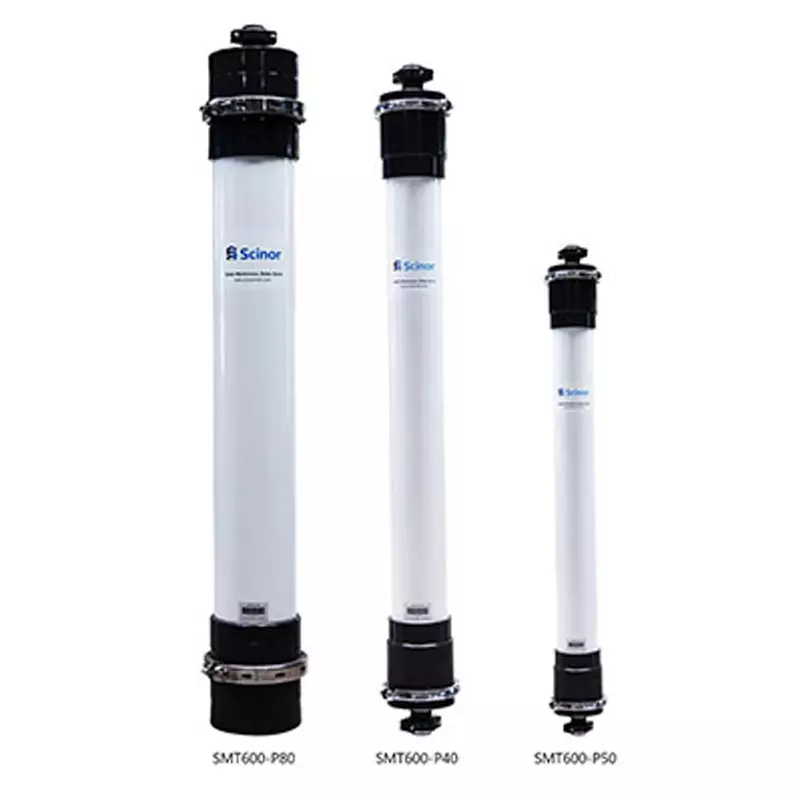
Ultrafiltration membranes are a type of microporous filtration membrane with uniform pore size specifications and a rated pore size range of less than 0.01 microns. By applying appropriate pressure on one side of the membrane, solute molecules smaller than the pore size can be screened out to separate particles with a molecular weight greater than 500 daltons (atomic mass units) and a particle size greater than 10 nanometers. Ultrafiltration membranes are among the earliest developed polymer separation membranes. In the 1960s, ultrafiltration devices were industrialized.
Which process is better for treating aquaculture wastewater?
With the development of rural areas, wastewater treatment has also become an indispensable part of rural life. There are many processes for wastewater treatment equipment. Which process is better for treating aquaculture wastewater? It should be noted that there are significant differences in economic development and terrain in rural areas, and the treatment of aquaculture wastewater is highly challenging. Therefore, when choosing wastewater treatment processes, local conditions should be taken into account, and the treatment process should be selected based on the local economic affordability and terrain features. The following introduces the advantages of a relatively suitable aquaculture wastewater treatment system for everyone.
The integrated equipment for aquaculture wastewater treatment features advanced technology and good treatment effect. It can remove ammonia and refractory organic matter, produce less residual sludge, occupy a small area, is not restricted by the setting location, is easy to operate and manage, and is easy to achieve automatic control. It is also easy to be transformed from traditional processes.
Advantages of the aquaculture wastewater system
The effluent is stable and up to standard
The application of HRLE technology in sewage treatment equipment has a very high interception rate for pollution. The leachate from the initial, middle and late stages can all stably meet the discharge standards, especially for the leachate from aquaculture waste in the middle and late stages, it has a great advantage. Water
2. The membrane has a long service life and is easy to maintain
(1) The HRLE module features a 3mm open wide flow channel and a unique deflector plate with protrusions. The feed liquid forms a turbulent state within the module, minimizing the occurrence of membrane surface scaling, contamination, and concentration polarization, reducing membrane fouling, and extending the lifespan of reverse osmosis membranes. In practical engineering, it has been found that for treating the raw liquid of seepage, the service life of the first-stage HRLE membrane package can be as long as 3 years, and that of the second-stage HRLE can be over 5 years. This is something that general reverse osmosis treatment systems cannot achieve.
(2) Any individual component within the HRLE component is allowed to be replaced separately.
3. Low investment and operating costs
The HRLE technology process flow of the integrated wastewater treatment equipment is relatively short, with low energy consumption and low investment and operating costs.
4. High degree of automation and simple operation
The HRLE membrane system is fully automatic. The entire system is equipped with a complete monitoring and control system. The PLC can automatically adjust according to the sensor parameters and issue alarm signals in a timely manner to protect the system. It does not have overly high requirements for the experience of the operators.
The sewage treatment equipment occupies a small area of 5
The HRLE membrane system is installed in an integrated manner, and the ancillary structures and facilities are also some small-scale ones, occupying a small area.