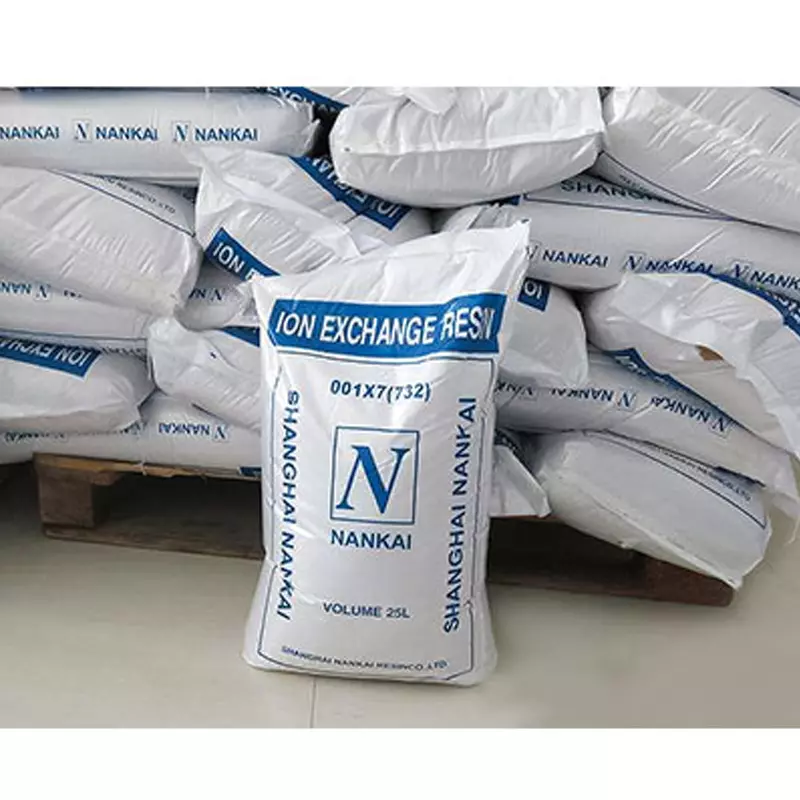
A type of resin, referring to the resin in ion exchange separation where the ions being exchanged are cations. It has wide applications in water treatment, medicine, chemical engineering and other fields. Ion exchange resin is a polymer with corresponding functional groups. Under normal circumstances, conventional sodium ion exchange resins carry a large number of sodium ions. When the content of calcium and magnesium ions in water is high, ion exchange resins can release sodium ions, and functional groups combine with calcium and magnesium ions. As a result, the content of calcium and magnesium ions in water decreases, and the hardness of water drops. Hard water turns into soft water. This is the working process of a water softening device. When a large number of functional groups on the resin combine with calcium and magnesium ions, the softening capacity of the resin decreases. A sodium solution can be passed through the resin. At this time, the sodium ion content in the solution is high, and the functional groups will release calcium and magnesium ions and combine with sodium ions. In this way, the resin regains its exchange capacity. This process is called "regeneration".
What requirements does the integrated wastewater treatment equipment have for valves?
The valves used in the integrated wastewater treatment equipment are mostly gate valves and ball valves. Rubber-lined diaphragm valves and pneumatic diaphragm valves are used on the equipment pipelines that use acids and alkalis. Therefore, valves are very important for the integrated wastewater treatment equipment. So, what are the requirements for valves in the integrated wastewater treatment equipment?
Both gate valves and ball valves are used to cut off the flow of medium in pipelines and play an isolation role. Gate valves are also known as gate plate doors, and ball valves are also called stop (stop) doors. The requirement for them is that there must be no loopholes. A hydrostatic test at 1.25 times the working pressure should be conducted on each valve. The flexibility of opening and closing of the valve should be checked, whether the packing meets the requirements should be inspected, and whether there is any rust on the valve stem at the packing seal.
Gate valves are widely used in pipelines. The main components of a gate valve are the valve body, valve cover, gate plate, valve stem, valve stem nut and packing. The sealing material for gate valves used in water treatment processes is rubber. A gate valve with a diameter of 100mm weighs more than 30kg. A 50mm gate valve weighs more than 60kg. Gate valves are mostly used on equipment pipelines with a pressure of less than 1 MPa.
Stop valves, also known as gate valves or ball valves, are mostly used in medium-pressure equipment pipelines with a pressure range of 1.6 to 3MPa. Rubber-lined diaphragm valves are used on equipment and pipelines that use acids or alkalis, while pneumatic diaphragm valves are used on equipment and pipelines that are automatically controlled or remotely operated. Rubber-lined diaphragm valves and pneumatic diaphragm valves are used in highly corrosive media with a temperature not exceeding 60℃, and their working pressure is below 0.6mpa
A stable supply of water quality is an important condition for safe production. The integrated wastewater treatment equipment features high stability, simple and convenient operation, and is equipped with UV ultraviolet rays and membrane filters.