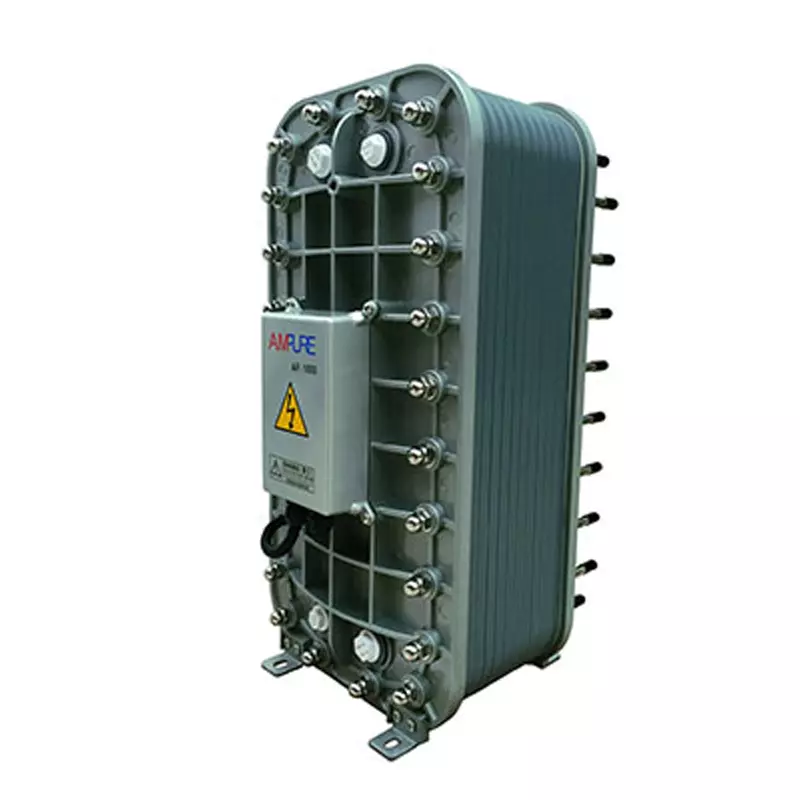
EDI(Elcctrodeionization) is a pure water manufacturing technology that combines ion exchange technology, ion exchange membrane technology and ion electromigration technology. It ingeniously combines electrodialysis and ion exchange technologies, using high voltage at both ends of the electrodes to move charged ions in water, and in combination with ion exchange resins and selective resin membranes to accelerate the removal of ions, thereby achieving the purpose of water purification. During the EDI desalination process, ions are removed through the ion-exchange membrane under the action of an electric field. Meanwhile, under the action of an electric field, water molecules generate hydrogen ions and hydroxide ions, which continuously regenerate the ion exchange resin to keep it in an optimal state.
The operation effect of the integrated wastewater treatment equipment
The integrated wastewater treatment equipment is an ideal solution based on the water resource supply situation. The prerequisite is that the wastewater generated during operation can be fully digested by the relevant water-using areas after treatment, and there is no wastewater directly discharged outside the factory area. So, what problems may arise during the implementation of zero discharge of pharmaceutical wastewater?
The wastewater generated is difficult to be completely collected.
1. The wastewater system of the entire factory is widely distributed and involves many specialties, making the collection of wastewater a major issue. Especially in areas such as the zero meter of the boiler room, the ash and slag removal system, and the coal conveying system, which are large in area, there are many water usage points and a large daily volume. Whether the distribution of wastewater channels is reasonable and whether the number of collection pits meets the wastewater discharge volume are the key points of wastewater collection. If all the wastewater cannot be collected, some of it will inevitably flow out from the rainwater and drainage Wells in the factory area, causing pollution to the factory area and its surrounding environment.
For power plants in the south, the groundwater level is high and the foundation is soft. Channels and water tanks are prone to cracking due to uneven settlement, which can lead to wastewater overflow or seepage and pollute the groundwater quality. In addition, if the ash yard is not properly treated for seepage prevention during construction, it can also lead to wastewater leakage and pollution.
Can all the wastewater be treated to meet the standards
All the drainage from power plants needs to undergo desalination treatment for reuse, which requires a large investment and high operating costs. From an economic perspective, it is not suitable. Some drainage with low pollutant content and relatively clear water quality, such as circulating cooling water drainage, cannot be fully reused due to its large volume. Environmental protection requirements do not define this part of the drainage as industrial wastewater. This part of the drainage will be discharged through the external outlet of the entire factory.
2. The operation effect of the integrated wastewater treatment equipment shows that the effluent quality continuously declines with the increase of operation time. Improper maintenance, repair and operation management of equipment can also lead to a decline in the quality of the effluent. In severe cases, it may result in the effluent quality failing to meet the design requirements.
3. In case of emergency situations such as large-scale leakage of acids, alkalis, oil stains, etc. during the production and operation process, improper response may also cause the wastewater discharge volume or impurity content to exceed the designed treatment capacity of the integrated wastewater treatment equipment, resulting in the wastewater not being treated up to standard and being reused or discharged.