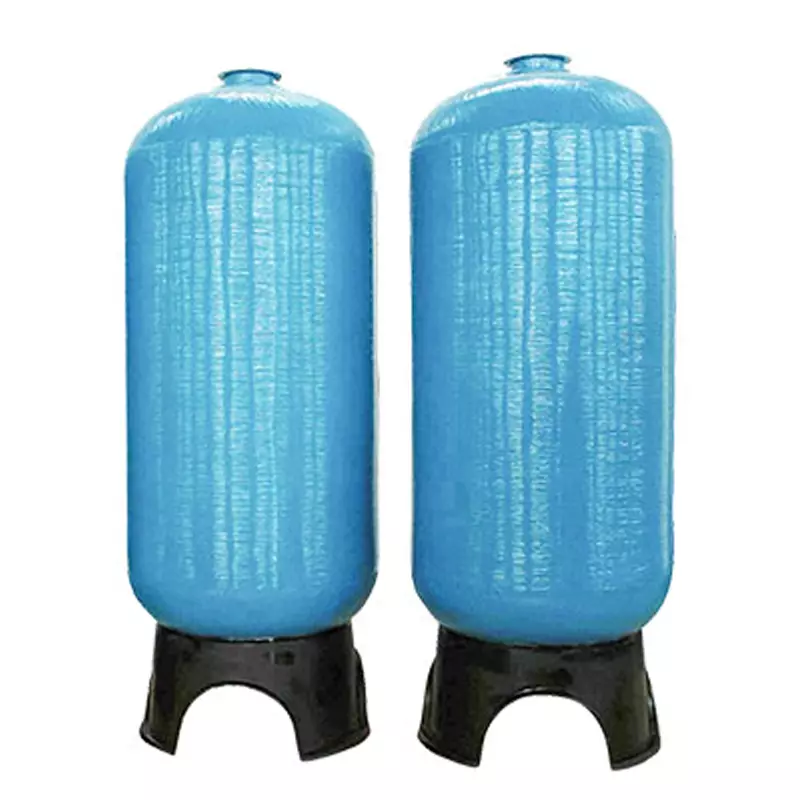
FRP products are made from FRP as raw material and are a new type of composite material developed abroad in the early 20th century. They mainly include FRP tanks, FRP storage tanks, FRP mixing tanks, FRP pipes, FRP pipes, etc. They have many advantages such as light weight, high strength, corrosion resistance, heat insulation, insulation, sound insulation and long service life.
How to solve the problems existing in the operation process of the integrated wastewater treatment equipment
The waste paper papermaking process has great potential for water conservation, but water conservation means a large amount of water reuse and the accumulation of pollutants. Through the zero-emission transformation of waste paper mills, many problems have been encountered, among which the main ones are as follows: the accumulation of salt, the accumulation of refractory pollutants, and the continuous increase in color. Microbial growth problems can cause paper defects such as voids and transparent spots on the paper surface. Complete wastewater circulation leads to the accumulation of salt, which can cause scaling in the integrated wastewater treatment equipment, clogging of the wool cloth and copper mesh, and the generation of bubbles that interfere with the papermaking process. The accumulation of salt can also cause corrosion problems. The secondary adhesive substances formed during the process deposit on the surface of the equipment, which can harm the papermaking process and cause problems such as white resin that are equivalent to resin obstacles and coating damage to paper.
Zero discharge of papermaking wastewater adopts a reasonable biological treatment process to solve the problem of pollutant accumulation: We believe that the reason for the odor of papermaking wastewater is biodegradable organic matter, which can also be said to be BOD in the wastewater. The removal of BOD in sewage is accomplished through the adsorption and metabolic actions of microorganisms, followed by the separation of sludge from water.
The anaerobic process can be divided into the hydrolysis stage, the acidification stage and the methanogenesis stage. The first two stages proceed relatively fast and are difficult to strictly separate in engineering. Hydrolysis acidification mainly converts insoluble macromolecular substances that need to be decomposed by extracellular enzymes to enter the metabolism of microorganisms into small-molecule organic substances that can be directly absorbed by microorganisms. Anaerobic hydrolysis acidification mainly improves and enhances the biodegradability and solubility of wastewater and degrades part of BOD. Under aerobic conditions, microorganisms in activated sludge A portion of the organic matter in the sewage is used to synthesize new cells, while another part is decomposed and metabolized to obtain the energy required for cell synthesis. The products are stable substances such as CO2 and H2O. During anabolic and catabolic processes, dissolved organic substances (such as low-molecular-weight organic acids, etc.) directly enter the cell interior for utilization, while non-dissolved organic substances are first adsorbed on the surface of microbiota and then hydrolyzed by extracellular enzymes before entering the cell interior for utilization.
Control the addition of fillers in production to reduce salt accumulation: The purpose of adding fillers in papermaking is to lower the cost of paper. Currently, the main objective is to endow paper with certain special properties. Due to the different purposes of filling, the proportion of fillers in the paper varies greatly, generally ranging from 10% to 20%. The use of one or several fillers depends on the special properties of the paper required. Among various types of paper, the amount of fillers used for printing paper and writing paper in the integrated wastewater treatment equipment is relatively large.
Fillers help improve the following properties of paper:
By filling the gaps in the paper sheet, the uniformity and smoothness of the paper sheet can be improved.
② Increase the opacity and whiteness of the paper (by using calcium carbonate).
③ Enhance printability.
④ Enhance dimensional stability.
⑤ Reduce the cost of paper. At the same time, filling also has adverse effects on paper and the papermaking process. It reduces the bonding between fibers, resulting in a decrease in paper strength. During printing, it is prone to shedding fibers and powder, and at the same time, it increases the abrasion of the paper machine.
⑥ Sizing agents are used to enhance the paper's resistance to water penetration.